Skip to Main Content
  • Sylvester Comprehensive Cancer Center |
  • Bascom Palmer Eye Institute

Awake Craniotomies

University of Miami Health
  • Appointments
  • Pay a Bill
  • Refer a Patient
  • International Patients
  • Donate Now
  • Search
  • Patient Login
  • Find a Doctor
  • Treatments Page 1
    Featured Treatments For
    • Allergy and Immunology
    • Arthritis (Rheumatology)
    • Bariatrics (Weight Loss Surgery)
    • Cancer (Oncology)
    • Cardiac and Vascular
    • Concierge Medicine
    • Dentistry
    • Dermatology
    • Diabetes
    • Ear, Nose, and Throat (ENT)
    • Emergency Care
    • Endocrinology, Diabetes and Metabolism
    • Executive Physicals
    • Eye Care (Ophthalmology)
    • Fertility Center
    • Gastrointestinal
    • Genetics
    • Geriatrics
    • Hematologic (Blood) Cancers
    • Hepatology
    • High Blood Pressure (Hypertension)
    • Infectious Diseases
    • Internal Medicine
    • Interventional Radiology
    • Lymphedema
    • Nephrology
    • Neurology
    • Neurosurgery
    • Obstetrics and Gynecology
    • Orthopaedics
    • Pain Management and Palliative Care
    • Pediatrics
    • Physical and Occupational Therapy
    • Physical Medicine and Rehabilitation
    • Plastic Surgery
    • Primary Care
    • Psychiatry
    • Pulmonary Medicine
    • Radiology
    • Sleep Medicine
    • Sports Medicine Institute
    • Surgery
    • Transplant
    • UHealth Comprehensive Women’s Health Alliance
    • UHealth Premier
    • Urology
    View all Treatments
    Browse A-Z A B C D E F G H I J K L M N O P Q R S T U V W X Y Z
    Featured Treatments For
    • Allergy and Immunology
    • Arthritis (Rheumatology)
    • Bariatrics (Weight Loss Surgery)
    • Cancer (Oncology)
    • Cardiac and Vascular
    • Concierge Medicine
    • Dentistry
    • Dermatology
    • Diabetes
    • Ear, Nose, and Throat (ENT)
    • Emergency Care
    • Endocrinology, Diabetes and Metabolism
    • Executive Physicals
    • Eye Care (Ophthalmology)
    • Fertility Center
    • Gastrointestinal
    • Genetics
    • Geriatrics
    • Hematologic (Blood) Cancers
    • Hepatology
    • High Blood Pressure (Hypertension)
    • Infectious Diseases
    • Internal Medicine
    • Interventional Radiology
    • Lymphedema
    • Nephrology
    • Neurology
    • Neurosurgery
    • Obstetrics and Gynecology
    • Orthopaedics
    • Pain Management and Palliative Care
    • Pediatrics
    • Physical and Occupational Therapy
    • Physical Medicine and Rehabilitation
    • Plastic Surgery
    • Primary Care
    • Psychiatry
    • Pulmonary Medicine
    • Radiology
    • Sleep Medicine
    • Sports Medicine Institute
    • Surgery
    • Transplant
    • UHealth Comprehensive Women’s Health Alliance
    • UHealth Premier
    • Urology
    View all Treatments
  • Locations
  • Patients & Families
    Quick links
    • Appointments
    • Pay a Bill
    • Make a Gift
    • Insurance Plans Accepted
    • MyUHealthChart
    • Advance Directives
    For Patients & Families
    • Your First Visit
    • Medical Records
    • Frequently Asked Questions
    • Patients & Families
    • Public Transportation
    • UHealth Clinic at Walgreens
    • Support Groups
    • Interpreter Services
    • International Patients
    • UMiami Health Talks
    About Uhealth
    • Why Choose UHealth
    • Benefits of an Academic Medical Center
    • Mission & Values
    • Leadership
    • Community Health Improvement
    • Nursing at UHealth
    • Health News
    • Miller School of Medicine
    • University of Miami
    • Careers
    • Volunteers
    • Contact Us
    Clinical Trials
    • Find a Clinical Trial
    • Understanding Clinical Trials
    • Clinical Trials FAQ's
    Traveling from overseas?
    We can help plan your visit. Learn More
    Quick links
    • Appointments
    • Pay a Bill
    • Make a Gift
    • Insurance Plans Accepted
    • MyUHealthChart
    • Advance Directives
    For Patients & Families
    • Your First Visit
    • Medical Records
    • Frequently Asked Questions
    • Patients & Families
    • Public Transportation
    • UHealth Clinic at Walgreens
    • Support Groups
    • Interpreter Services
    • International Patients
    • UMiami Health Talks
    About Uhealth
    • Why Choose UHealth
    • Benefits of an Academic Medical Center
    • Mission & Values
    • Leadership
    • Community Health Improvement
    • Nursing at UHealth
    • Health News
    • Miller School of Medicine
    • University of Miami
    • Careers
    • Volunteers
    • Contact Us
    Clinical Trials
    • Find a Clinical Trial
    • Understanding Clinical Trials
    • Clinical Trials FAQ's
Patient Login
  • University of Miami Health System
  • Treatments and Services
  • Neurosurgery
  • Awake Craniotomies

Awake Craniotomies

Appointments Appointments Doctors Doctors Locations Locations Clinical Trials Clinical Trials

Appointments

Call or click for an in-person
or virtual visit.

Call us at
305-243-6946

Or

Insurance Plans

View a list of insurance plans accepted at the University of Miami Health System.

A craniotomy is an intricate neurological procedure performed by opening the skull, performing the needed surgery, and closing the skull by securing the bone into its original position. An awake craniotomy, or awake brain surgery, is a minimally invasive surgery where the patient is awake during the procedure. Awake craniotomies require less bone removal and limit the injury done to surrounding brain tissue, significantly reducing the impact on your quality of life.
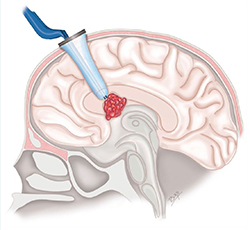
ViewSite Brain Access System
Illustration depicting transsulcal insertion of ViewSite Brain Access System tubular retractor. The retractor is inserted transsulcally to minimize cortical trauma. The rounded shape of the retractor is thought to spread white matter tracts rather than transecting them, thus preserving them to the maximal extent possible.

Expert neurosurgeons at the University of Miami Health System use awake craniotomies to remove complex brain tumors while working to preserve speech and language function. We are one of only a handful of neurosurgeons in the United States who perform awake craniotomies.

What is a Complex Brain Tumor?

A complex brain tumor is an abnormal growth in the brain that is close to critical areas, such as near those areas of that brain that control speech and movement. Removing only the tumor — while preserving precious brain tissue and bodily function — is a complicated procedure that can only be successfully performed by expert neurosurgeons.


Who is a Candidate?

If you have a complex brain tumor, your neurosurgeon may recommend you undergo an awake craniotomy to help preserve your speech and language abilities.


What to Expect

During an awake craniotomy, our neurosurgeons and neurologists use advanced brain-mapping techniques to identify and avoid injury to the sites of language, motor, and sensory function. We do this by using electrical currents to stimulate specific areas of the brain, and then using imaging to determine if that electrical current is impacting the brain area. For example, when a tumor is near critical speech areas of the brain, it is important to determine the exact location of these speech-related areas to avoid affecting them.

An awake craniotomy is performed on an inpatient basis in the hospital, meaning that you’ll expect to spend the night after your procedure. You will be under full anesthesia (asleep) when the procedure begins. Your surgeon will make an incision in your head near the area of skull they need to remove temporarily to reach the tumor.

Once your neurosurgeon reaches the area of your brain where the tumor is, the sedation will be slowly lifted to allow you to be “awake” and communicate with your surgical team. Our specialists use imaging techniques – such as magnetic resonance imaging (MRI) or computerized tomography (CT) scans – to locate the exact areas of the brain used for language, muscle skills, and sensation.

Your neurosurgeon will ask you to talk, move, and follow commands. If the electric stimulation affects your ability to perform any of these tasks, then the surgeon knows to avoid the area and leave it intact because it is not affected by the tumor. Once the tumor is removed, you will be sedated again while the surgeon finishes the operation. Your skull will be placed back in position, and the incision will be closed with stitches and covered with a sterile dressing.

After the procedure, you will be monitored closely for 24 to 48 hours. You should be able to eat, drink, and move around – with help – soon after the procedure. You will likely return home from the hospital a few days after the awake craniotomy, and then see your neurosurgeon for a post-operative visit about a week later.

Questions? We're here to help.

Our appointment specialists are ready to help you find what you need. Contact us today.

Call 305-243-6946 Request an Appointment

logo
alt="Twitter Logo">
USNWR Best Hospitals 2025-2026 USNWR Best Regional Hospitals 2025-2026
Quick links
  • Appointments
  • Find a Doctor
  • Pay a Bill
  • Insurance Plans Accepted
  • MyUHealthChart
  • Make a Gift
Patient & Families
  • Frequently Asked Questions
  • Medical Records
  • Interpreter Services
  • Clinical Trials
  • International Patients
  • UHealth Clinic at Walgreens
  • Support Groups
  • Price Transparency
  • Florida Health Finder
Healthcare Professionals
  • Refer a Patient
  • Physician & Executive Recruitment
  • Advanced Practice Providers
  • Immunology & Histocompatibility Laboratory
  • Nursing
  • Sleep Center
  • Sports Medicine Institute
  • Pathology Reference Services
About Uhealth
  • Why Choose UHealth
  • Benefits of an Academic Medical Center
  • Mission & Values
  • Leadership
  • Community Health Improvement
  • For Media
  • Miller School of Medicine
  • University of Miami
  • Careers
  • Volunteers
  • Supply Chain
  • Contact Us

University of Miami Centennial Logo

Medical Disclaimer | Terms of Use | Privacy Statement | HIPAA Notice of Privacy Practices | Non-Discrimination Policy | No Surprises Billing Rights
© 2025 University of Miami Health System. All rights reserved.